
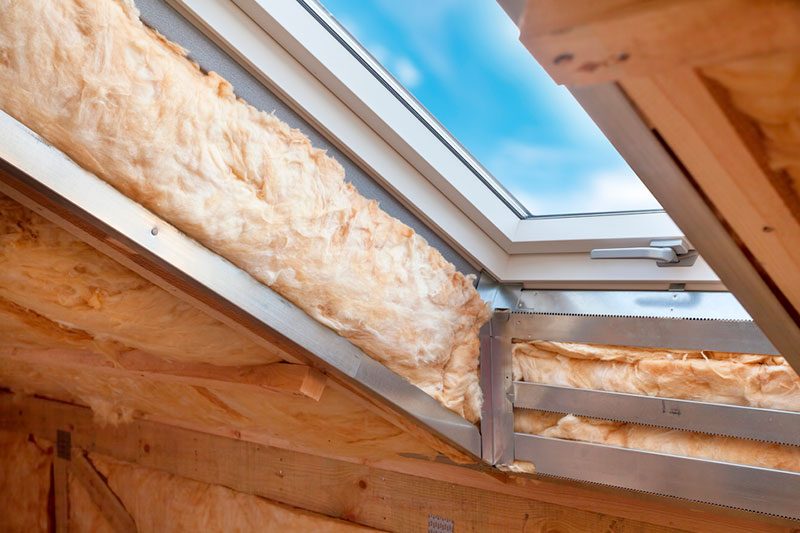
Thermal insulation is one of the most important, cost-effective and energy-saving construction elements in a home. Undoubtedly, it is an important element to take into account in our renovation project as it is responsible for keeping the home cooler in summer and warmer in winter. In addition to its thermal solution, it is used as an acoustic solution in walls, ceilings and in every part of the envelope of our home.
Depending on the material used to make the thermal insulation, two main types can be distinguished: mineral insulators and synthetic insulators. Each one has different characteristics but the factors that will define how well insulated our house will be are the density of the material and the thickness we give it.
Despite the wide variety of insulation materials available, the most commonly used are extruded polystyrene, expanded polystyrene and rock wool. The choice of material and its thickness for our renovation project is a technical issue for the execution of the work and it is up to the architect to advise you properly in this decision.

How much can be saved with good thermal insulation?
According to a report on efficient energy use by the National Institute of Industrial Technology (INTI), about half of the energy consumed in a home is used for air conditioning (air conditioning in summer and heating in winter).
Well, up to 30% of that energy ends up escaping through poorly insulated roofs or no insulation at all.
To achieve a good thermal insulation in a project or housing reform, in addition to a good insulator, it is necessary to have a series of conditions that we list below:
1. Properly insulate walls and floors facing outdoors.
Either to the street or to an interior courtyard. The thickness will vary according to the material chosen and the Spanish regulations establish minimums depending on your location. Zaragoza belongs to climate zone D3, therefore the thermal transmittance value for walls and floors in contact with the outside air cannot exceed 0.41 W/m2K.
The real savings can be reflected by drawing up an energy certificate for the house, a document that must be drawn up by a competent technician. You can request it in our architecture studio in Zaragoza.

2. Window insulation
To have windows with double glazing system with an air/gas chamber inside and thermal bridge break. This type of window is considered the standard in any architectural project. So if your home is new or you are going to renovate it soon, any company has windows with these characteristics.
3. Insulate the roofs of the house
Properly insulate the roofs of the dwelling (this condition is mainly necessary in single-family dwellings or attics in residential blocks). As we know, heat tends to rise, so it is useless for your home to be protected on the sides (walls and windows) if we do not invest in the enclosure that keeps the heat inside and prevents it from escaping. In this case, the transmittance value of our roof located in Zaragoza should not exceed 0.35 W/m2K.

4. Find and solve thermal bridges in our envelope.
It is a problem that is more common than it seems and may be causing us to expend much more energy than necessary. This is something that will depend a lot on the condition and good execution of the property. It is not easy to identify these points, so it is necessary to have them checked by a technician if we want to obtain a good diagnosis. In our architecture studio in Zaragoza we identify and solve any problem that may have the envelope of your home and we take care of the renovation project that best suits your needs.
5. Air leaks.
What is the point of having good insulation without thermal bridges, if the outside air enters the interior of the house. We refer to air leaks between the construction elements that separate the interior and exterior of the house. The most common places where leaks occur are the edges of windows where it meets the wall.

In short, there are many reasons that make our home less efficient and what is clear is that avoiding these factors brings numerous advantages to our home:
They reduce energy consumption, saving on the electricity bill, promote a more pleasant and comfortable environment inside our home by maintaining a more stable temperature and help to care for the planet by significantly reducing electricity consumption.
Written by David Velilla Mínguez, published by Cronotopos.